

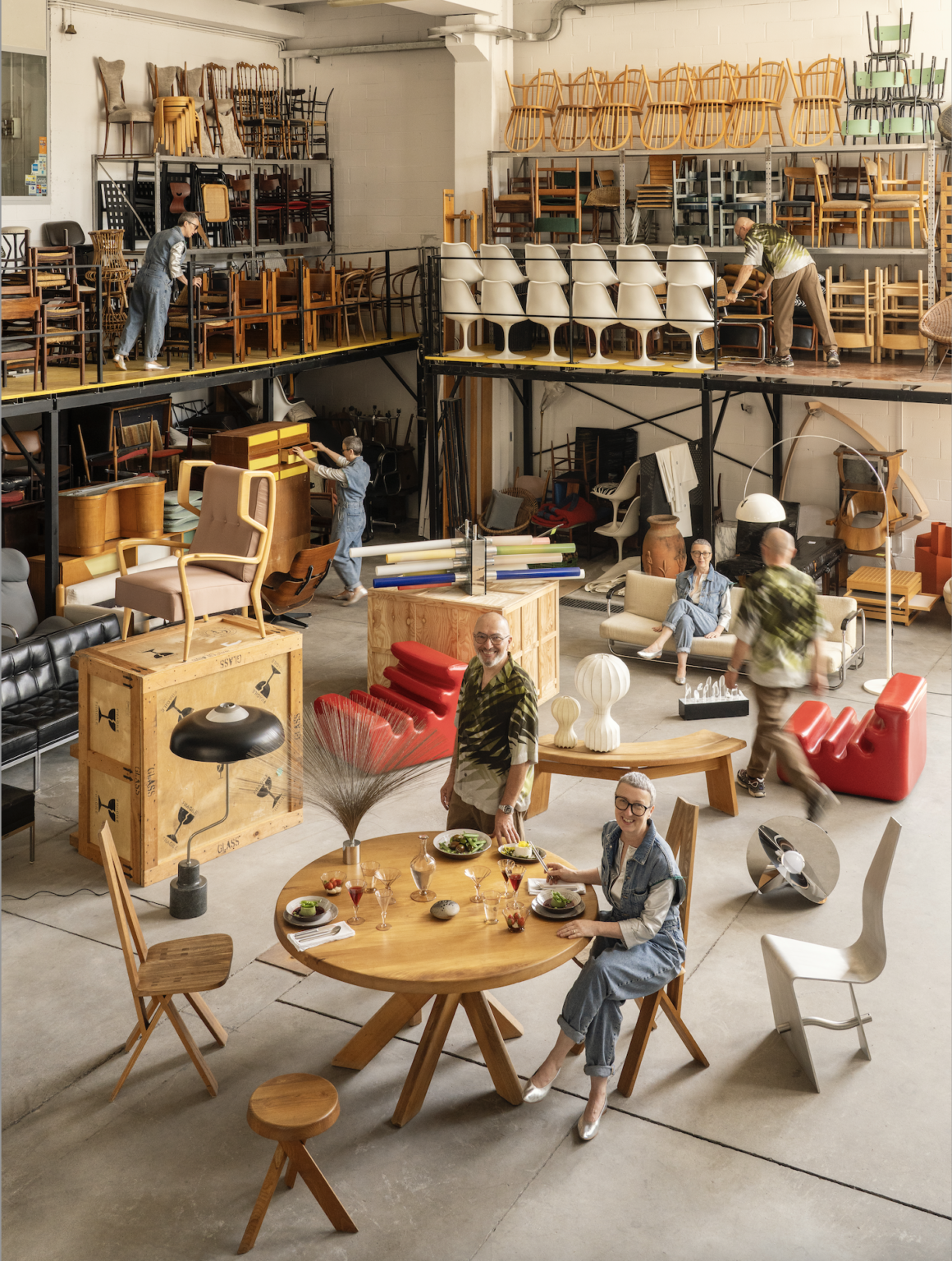
There are objects that simply furnish a space, and there are objects that seem to tell us something the moment they enter a room.
That is what we look for when we select an original vintage piece of furniture. Not simply a beautiful shape or a functional object, but something that has travelled through time and still preserves, in its materials, proportions, construction techniques and even in the small marks on its surface, the period in which it was designed and made.
For us, this is one of the most fascinating aspects of historic design.
In 20th-century design, this difference becomes even more apparent. A chair by Gio Ponti, an armchair by Ico Parisi, a piece by Osvaldo Borsani, a project by Carlo Scarpa or an object by Mathieu Matégot does not represent simply a particular idea of form.
These are fragments of a design culture that crossed countries, generations and different ways of understanding the relationship between industry, craftsmanship and everyday life.
When we choose an original, we are therefore choosing something that genuinely belongs to that history.
Our Role: Bringing the History of Design Back to Light
There is, however, an aspect of design history that is still too rarely discussed: the role played by those who, over the decades, have continued to search for, acquire, recover, restore and document original 20th-century objects.
We, as dealers in historic design, have been — and continue to be — part of this process.
We looked for these pieces when they were often not yet appreciated for what they represent today. We found them in private homes, warehouses, markets, private collections and family archives.
We recovered them, studied them, restored them when necessary and, above all, researched and documented their history.
We reconstructed attributions, manufacturers, production periods, materials and provenance. We compared objects with catalogues, archival material, photographs and publications. We helped preserve the memory of projects that might otherwise have been forgotten.
This work is not limited to Italian design.
Over the years, we have also helped bring attention back to an extraordinary international design culture: from Mathieu Matégot to Scandinavian design by Finn Juhl, Hans J. Wegner and Arne Jacobsen, from Brazilian modernism represented by Joaquim Tenreiro and Sergio Rodrigues to the German school of Dieter Rams and Hans Gugelot, and the Swiss design tradition of Max Bill and Willy Guhl.
These designers came from different cultures and had very different languages, but they shared something that remains fundamental to us: the quality of the design and the ability to transform construction into a form made to last.
This work, often carried out for years away from the spotlight, has helped many of these objects regain their place as classics of 20th-century design.
Today, we see major manufacturers bringing many of these designs back into production. It is an important recognition, and it demonstrates how contemporary many of these designs still are.
But we should remember one thing.
Before they returned to the market, these objects were already there. They were the originals.
And for many years, it was people like us who searched for them, recovered them, preserved them and told their story.
Original Vintage Furniture and Contemporary Reissues
Today, many important designs from the past are being produced once again. We understand this phenomenon and, in many ways, consider it positive: it allows new generations to discover important objects and brings forms that shaped design history back into contemporary homes.
But an original vintage piece remains something different.
A contemporary production may reproduce a historic design with great precision, respecting its proportions and using apparently similar materials. Yet it is born in a different moment and belongs to a different production context.
An original, on the other hand, was made in the period when the design itself became reality.
It experienced the techniques available at the time, the materials selected by the manufacturer, the hands of craftsmen and the industrial processes of its era. It has lived through part of design history.
It is not simply an older version of a reproduction. It is the historic object from which the reproductions originate.
And this is where, for us, a fundamental difference emerges.
An International Heritage of Design
When we talk about historic design, we do not want to limit ourselves to the great Italian icons.
The 20th century was an extraordinary period of international exchange.
In France, Mathieu Matégot transformed industrial materials such as perforated metal and textiles into forms that were light and almost graphic.
In Scandinavia, designers such as Finn Juhl, Hans J. Wegner and Arne Jacobsen developed a design culture in which ergonomics, wood, proportion and simplicity became inseparable elements.
In Brazil, figures such as Joaquim Tenreiro and Sergio Rodrigues interpreted modernism through materials, techniques and a sensitivity deeply connected to their local culture.
In Germany, the rigorous approach of Dieter Rams and Hans Gugelot helped define an idea of design based on function, clarity and the elimination of the unnecessary.
In Switzerland, Max Bill and Willy Guhl developed an equally rigorous approach, combining form, function and experimentation with materials.
When we look at these different paths together, we understand how international the design of the 20th century really was.
And that is precisely why, when we select a historic piece, we do not look only at its geographical origin.
We look at its design history.
We look at how a designer approached materials, production, function and the relationship between an object and the person who would use it.
This is what makes a piece truly interesting to us.
The 20th Century Was Not Afraid to Build for Permanence
When we examine many original 20th-century pieces of furniture closely, what strikes us is not only the design.
It is the construction.
The quality of the structures, the precision of the joints, the thickness of the materials, the care given to finishes and the possibility of repairing and restoring an object decades later.
These are details that are often invisible in photographs.
That is why we believe that an original should also be examined through the eyes of someone who understands how it was made.
An armchair is not simply its silhouette. A table is not simply its top. A chair is not simply its shape.
Behind every design lies a culture of making.
And it is precisely this culture that we try to preserve when we recover a historic piece.
Original Pieces and Reissues: Two Different Production Worlds
Contemporary reissues undoubtedly have the merit of making important historic designs accessible to a wider public.
But we should not confuse visual fidelity with authenticity of construction.
Many original pieces from the 20th century were produced in a manufacturing environment profoundly different from today’s. At the time, greater emphasis was often placed on durability, material quality, structural strength and the possibility of repairing and preserving an object over time.
When we examine an original, we often find a construction designed to last for decades.
Contemporary reissues, on the other hand, inevitably belong to today’s manufacturing and commercial system. They have to respond to different demands: large production volumes, cost optimisation, current regulations, new production technologies, international distribution and a market characterised by a much faster pace of consumption.
This does not mean that a reissue is necessarily a low-quality product.
It means that it belongs to another era and another way of producing.
For us, this distinction is essential.
An original tells the story of the industrial and artisanal world that produced it. A reissue also tells the story of our present, with its own production and commercial logic.
Why Choose an Original Piece of Furniture?
When we choose a piece of historic design, we are not simply looking for a famous object.
We are looking for an object that has something to say.
It might be a rare armchair by Jean Royère, a metal structure by Jean Prouvé, a project by Charlotte Perriand, a creation by Pierre Jeanneret, a lamp by Serge Mouille, a piece of furniture by George Nakashima or one of the extraordinary works of Pierre Chareau.
These designers left a profound mark on the history of international design and their original works remain highly sought after by discerning collectors.
But even here, for us, the designer’s name is only the starting point.
What interests us above all is the object in front of us.
Its period. Its manufacturer. Its materials. Its construction. Its proportions. Its patina. Its provenance.
We want to understand whether a particular Royère armchair is genuinely an original from its period, whether a Prouvé structure retains the characteristics of its original production, and whether a Perriand design genuinely belongs to the historical period we are documenting.
This is where our work acquires its value.
We do not simply sell a name. We search for, identify, recover and tell the story of an original.
Because there is a profound difference between a contemporary object inspired by a great master and a piece that was actually produced at the moment when that design was created.
And it is precisely that difference that we seek to preserve.
Why Choose an Original Gio Ponti Piece?
We think of Gio Ponti as one of the most significant examples for understanding the value of an original.
Architect, designer, artist and editor, Ponti experienced much of the history of 20th-century Italian design, leaving a distinctive mark on both architecture and furniture.
His designs continue to be produced, studied and reinterpreted. But standing in front of an original vintage Gio Ponti piece means having a different relationship with that design.
A chair, armchair, table or piece of furniture produced during Ponti’s era retains a direct connection with the moment when that idea was transformed into a real object.
This is where, in our view, an important part of the fascination of historic design begins.
We do not look only at the drawing.
We look at how that drawing was constructed, which materials were used, which manufacturer produced it and how the object has travelled through time to reach us.
What Makes an Original Authentic?
When we select a piece of historic design, authenticity is never determined by a single element.
The date or production period is important, as are the manufacturer, materials, construction techniques, finishes and the details that allow us to identify a particular model.
Provenance can also tell us a great deal.
Added to this are the condition of the piece, any restoration work and all available documentation.
These details may seem technical, but to us they become part of the object’s identity.
An original is not only what we can see.
It is also everything we can reconstruct about its history.
The Beauty of Patina
There is also something that no contemporary production can truly reproduce: time.
This is one of the aspects that fascinates us most about original vintage furniture.
Wood slowly changes colour. A surface acquires depth. A material can develop a softness that only the passing years can create. Small marks can tell us that an object has been used, lived with, moved, cared for and loved.
Patina is not necessarily imperfection.
When a piece has been well preserved, it can become part of its beauty and identity.
Naturally, we always evaluate a vintage piece according to its actual condition. A good restoration can restore dignity and functionality to an object, while inappropriate interventions can alter its characteristics and value.
When respected, time does not necessarily damage an object: it can become part of its story.
Vintage Original Does Not Simply Mean Old
For us, it is important not to confuse age with authenticity.
An old object is not automatically a piece of historic design.
In the case of an original Gio Ponti piece, for example, we consider the model, manufacturer, production period, materials and construction details. Whenever available, documentation also helps us reconstruct the object’s journey.
This is where our expertise comes into play.
Selecting historic design means knowing the designers, manufacturers, different production periods and the transformations a particular model may have undergone over the years.
An authentic piece must be understood and placed within its historical context.
This research allows us to give every object the right context and to tell its story not only for what it is, but also for what it represents.
Our Work Has Helped Bring These Objects Back into the Present
We believe that dealing in historic design is not simply a matter of buying and selling.
It is also a form of preserving memory.
When we recover an original piece of furniture, we give it renewed attention. When we reconstruct its provenance, we strengthen its identity. When we photograph it, catalogue it and present it to a new audience, we help keep its story alive.
It is through this process that many forgotten objects have once again been recognised as classics of 20th-century design.
And today, when we see some of these designs being produced again by major manufacturers, we also recognise the journey that brought them back into the spotlight.
The reissues came later.
The originals were already there.
They were in our collections, our warehouses, our research, our restoration projects and our documentation.
Before they were produced again, these objects had to be rediscovered.
And that rediscovery also came through the work of dealers, collectors, antique specialists and scholars who continued to believe in their value when the market still regarded them simply as furniture from the past.
20th-Century Design Is an International Story
When we think about 20th-century design, we see a network of influences that goes far beyond national borders.
Italy, France, Scandinavia, Germany, Switzerland, Brazil and many other countries together created one of the most fascinating periods in the history of design.
Gio Ponti, Franco Albini, Ico Parisi, Osvaldo Borsani, Carlo Scarpa, Afra and Tobia Scarpa can be seen in dialogue with Mathieu Matégot, Finn Juhl, Hans J. Wegner, Arne Jacobsen, Joaquim Tenreiro, Sergio Rodrigues, Dieter Rams, Hans Gugelot, Max Bill and Willy Guhl.
Different languages, but part of the same great story.
A story of materials, technique, proportion, innovation and culture.
This is the history we look for when we select an original piece.
An Original Piece Can Still Live in the Present
One of the most beautiful things about historic design is that it does not need to be preserved like a relic.
An original vintage piece of furniture can continue to live.
A Gio Ponti armchair can enter a contemporary apartment. An Ico Parisi table can interact with minimalist architecture. A 1950s Italian lamp can find its place alongside completely contemporary objects.
It is precisely this contrast that often makes an interior interesting.
We love seeing historic pieces living in the present, without forcing them to recreate an interior from the past.
A historic piece does not need to stand alone.
It can enter into dialogue with its surroundings and continue to tell its story while preserving its identity.
The furniture changes its environment, but it does not change its era.
Choosing an Original Means Choosing a Story
Ultimately, for us, the difference between an original and a reproduction is not merely aesthetic.
It is a difference in our relationship with time, materials and the way things were made.
An original vintage piece of furniture was genuinely produced within the historical context to which it belongs. It has travelled through decades, preserving materials, techniques, details and traces of its own life.
A reissue can bring a design from the past into the present.
An original, however, brings the past into the present.
This is why, when we select a piece of historic design, we look for something that goes beyond the simple beauty of its form.
We look for authenticity of design, quality of materials, the trace of time and the story that the object carries with it.
We also believe it is our responsibility to continue explaining why these objects deserve to be known, preserved and lived with.
Because an original Gio Ponti piece, an original Mathieu Matégot, a Finn Juhl chair, a Willy Guhl design or a rare example of Brazilian modernism is not simply a piece of furniture.
It is a testimony to a design culture that belongs to history and can still live today.