

Description
Eileen Gray: Life, Architecture and Design. The Story of the Iconic E1027 Table and Its German Production
Eileen Gray: An Outstanding Figure in 20th-Century Design
Eileen Gray (1878–1976) was one of the most original and innovative figures in the history of 20th-century design and architecture. An Irish-born designer, architect and artist, she lived through some of the most important periods of European cultural history, developing a personal and independent language that anticipated many of the principles of Modernism.
Born on 9 August 1878 in County Wexford, Ireland, Kathleen Eileen Moray Smith, known as Eileen Gray, came from an Anglo-Irish family of aristocratic origins. She studied at the Slade School of Fine Art in London before continuing her education in Paris at the Académie Julian and the École Colarossi.
Her move to Paris in 1902 marked a fundamental turning point in her life. At the time, the city was one of the leading international centres of artistic and cultural research, and Gray became part of an exceptionally stimulating creative environment.
She was initially drawn to lacquer work, a decorative technique of Oriental origin, which she explored through her studies with specialist craftsmen, including the Japanese master Seizo Sugawara. Her mastery of this technique enabled her to create furniture, decorative panels, screens and lacquered surfaces of extraordinary refinement.
Her early works are distinguished by a combination of traditional craftsmanship, modern geometry and remarkable sensitivity to colour. Her work attracted the attention of important collectors and patrons, including the couturier Jacques Doucet, for whom she designed several furnishings.
In 1922, she opened Galerie Jean Désert in Paris, an exhibition and retail space where she presented her furniture, rugs and decorative objects.
From Art Deco to Modernism
During the 1920s, Eileen Gray’s creative research underwent a profound transformation. Without abandoning her artistic and craft-based background, she became increasingly interested in architecture, the functionality of objects and the new possibilities offered by industrial materials.
Her design language gradually moved away from the decorative richness of her early creations towards essential forms, geometric structures and innovative technical solutions.
Tubular steel, glass, reflective surfaces and industrial materials became established elements of her design vocabulary.
In 1929, she became associated with the Union des Artistes Modernes, a movement that brought together leading figures in modern French design and architecture.
Her vision, however, always remained independent. Unlike many of her contemporaries, Gray did not regard functionality as a purely technical principle: every object had to respond to people’s practical needs, offering comfort, freedom of movement and aesthetic quality.
This attention to the human dimension of living remains one of the most relevant aspects of her work.
E1027: The Mediterranean House and a New Concept of Living
Between 1926 and 1929, Eileen Gray designed and built the celebrated Villa E-1027, in collaboration with the Romanian architect and critic Jean Badovici. Located in Roquebrune-Cap-Martin on the French Riviera, the house is one of the most significant expressions of European Modernism.
Known as Maison en bord de mer, it was not simply a matter of designing a building, but of conceiving an environment in which architecture, furniture, lighting and everyday objects formed part of a single, coherent project.
Every element was designed around the habits and needs of its occupants. Transformable furniture, movable surfaces, integrated furnishings and space-saving solutions demonstrate an exceptionally advanced approach to interior design.
The villa was conceived as an architecture open to the Mediterranean landscape, where natural light, terraces, openings and interior spaces were in constant dialogue.
The name E-1027 conceals an affectionate code combining the initials of its two protagonists: E stands for Eileen, 10 for the letter J in Jean, 2 for the B in Badovici and 7 for the G in Gray.
It was specifically for this house that Eileen Gray designed some of her most important pieces of furniture, including the adjustable E1027 table, destined to become one of the great icons of 20th-century design.
The E1027 Table: A Masterpiece of Functionality and Lightness
Designed in 1927, the E1027 table is probably Eileen Gray’s best-known creation and one of the finest examples of how Modernism transformed an everyday object into a project of remarkable ingenuity.
Its conception originated from a practical need: to create a versatile, lightweight and adjustable table capable of adapting to different domestic situations.
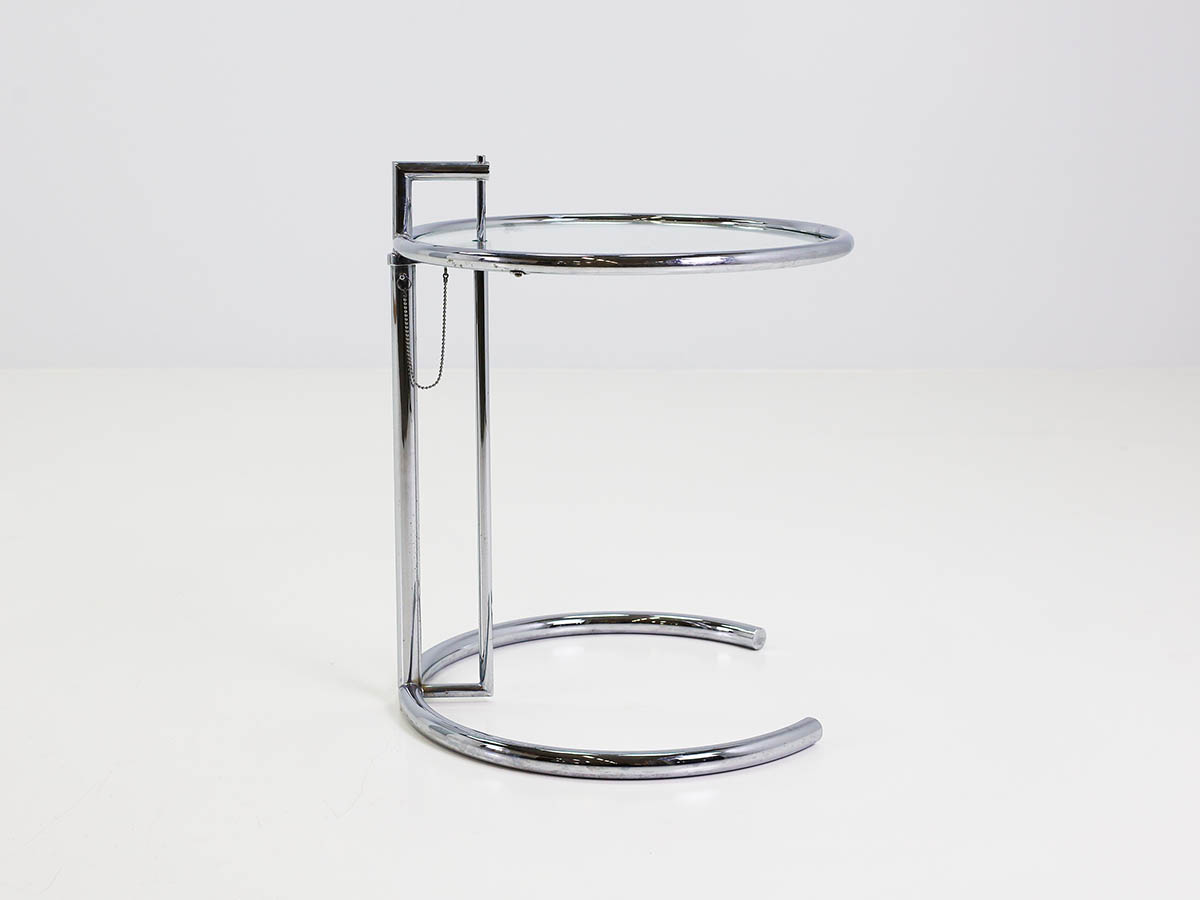
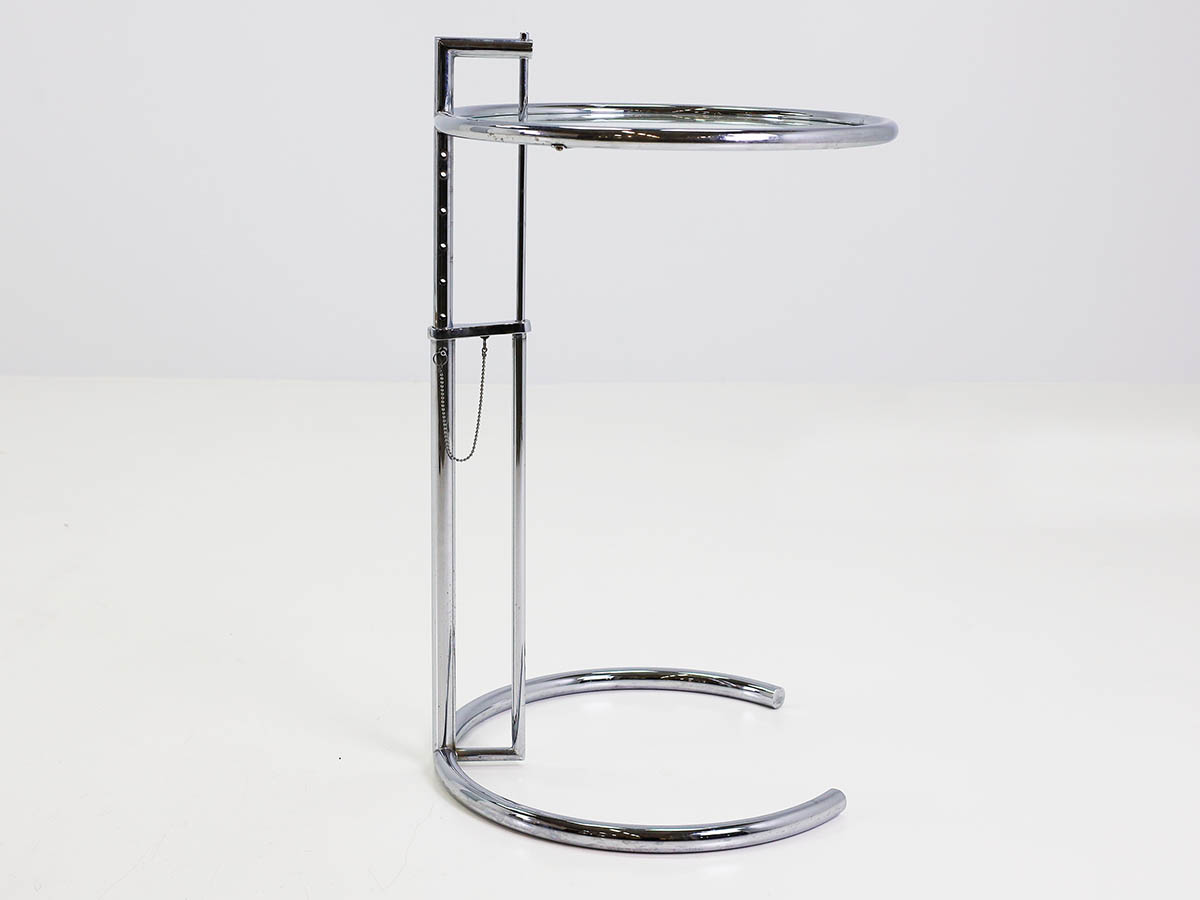
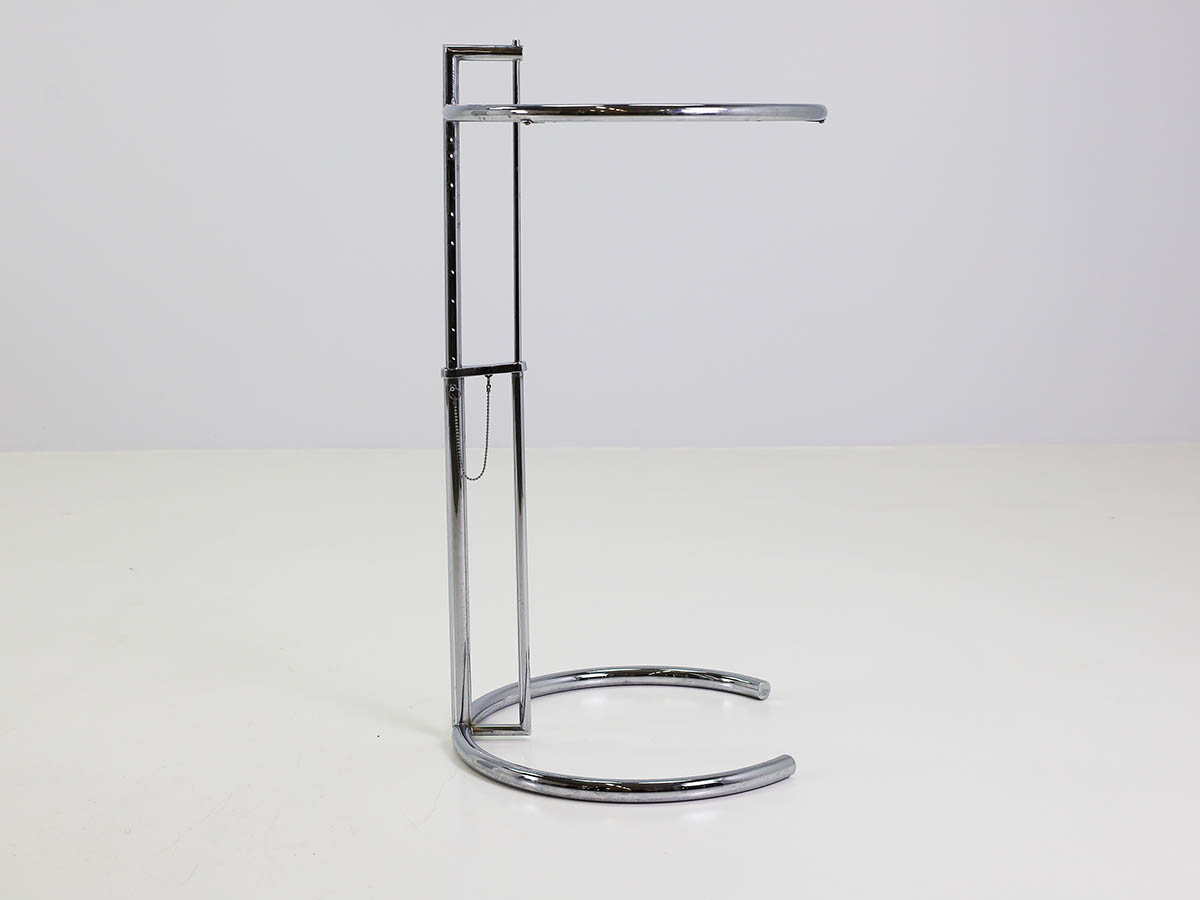
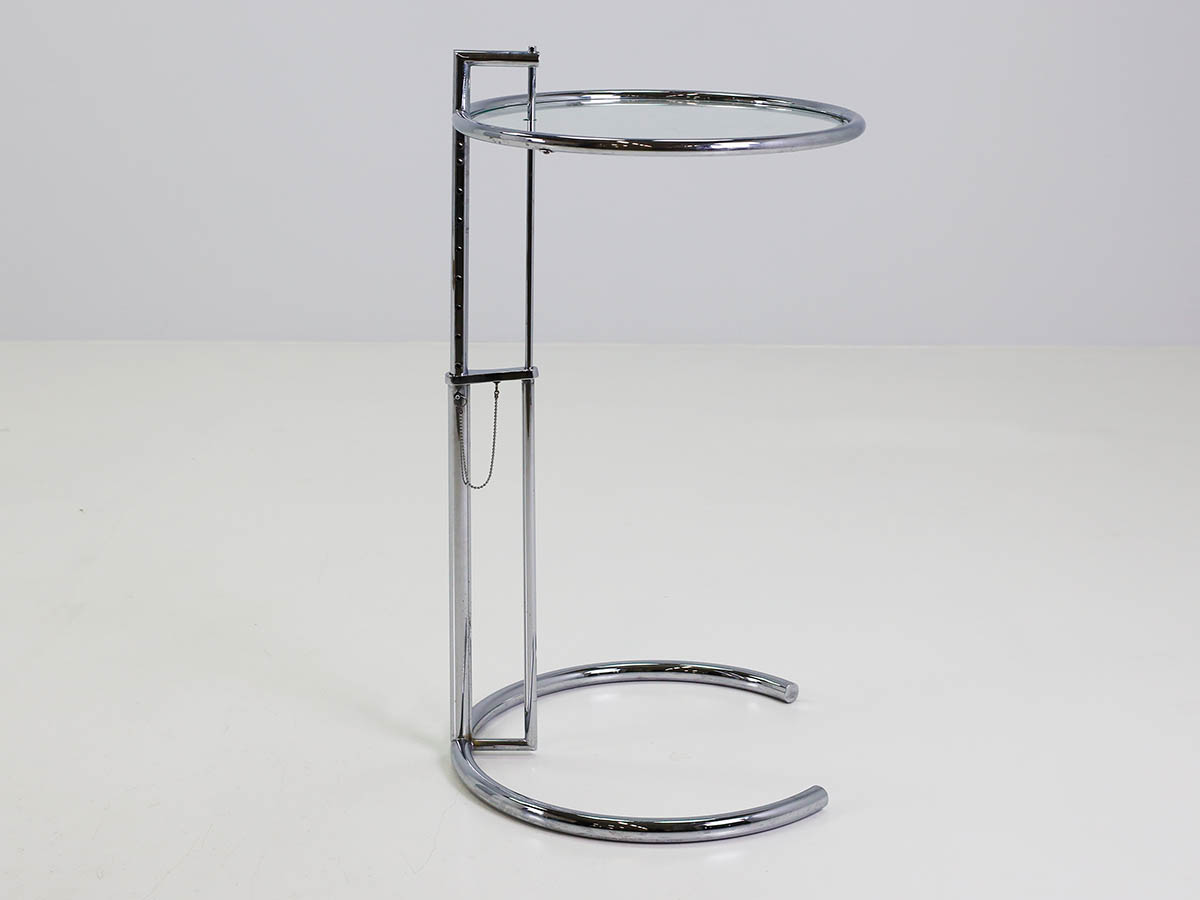
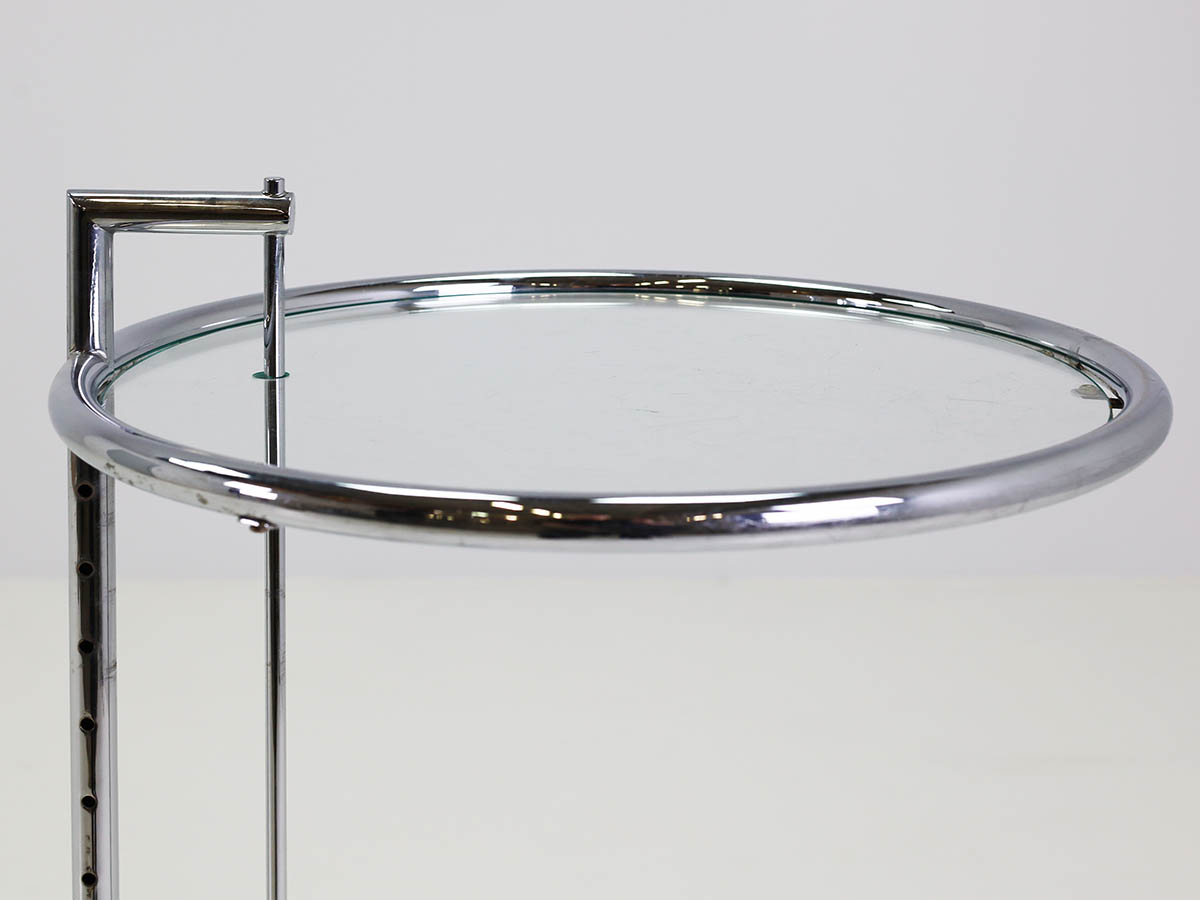
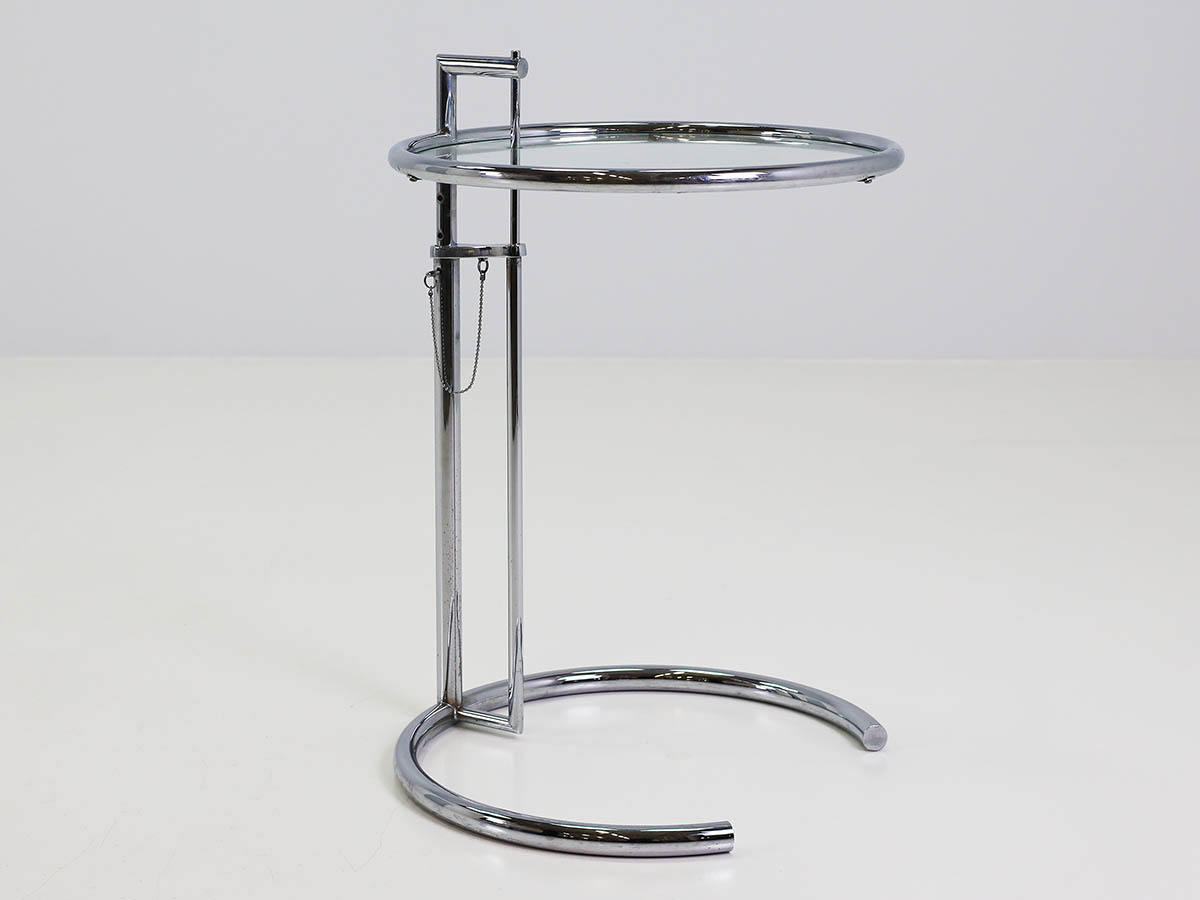
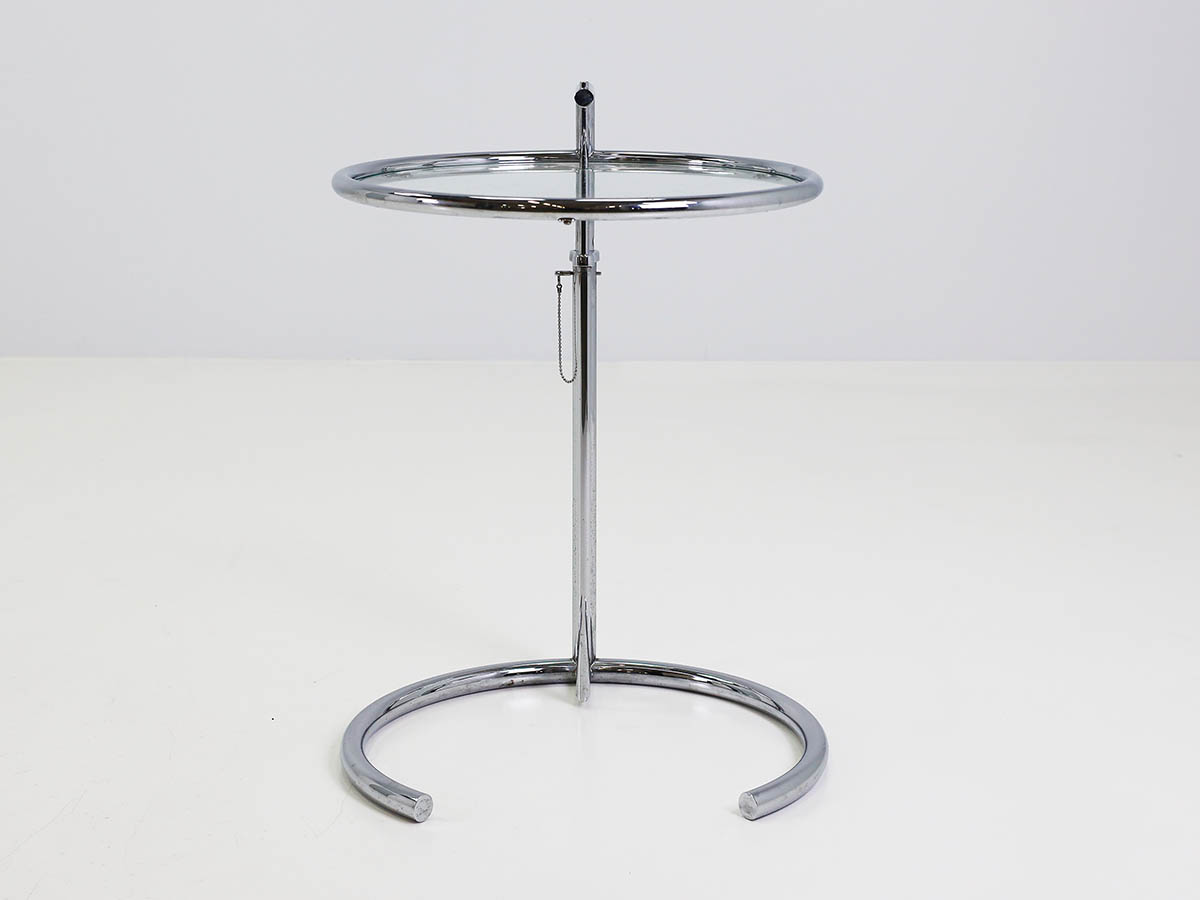
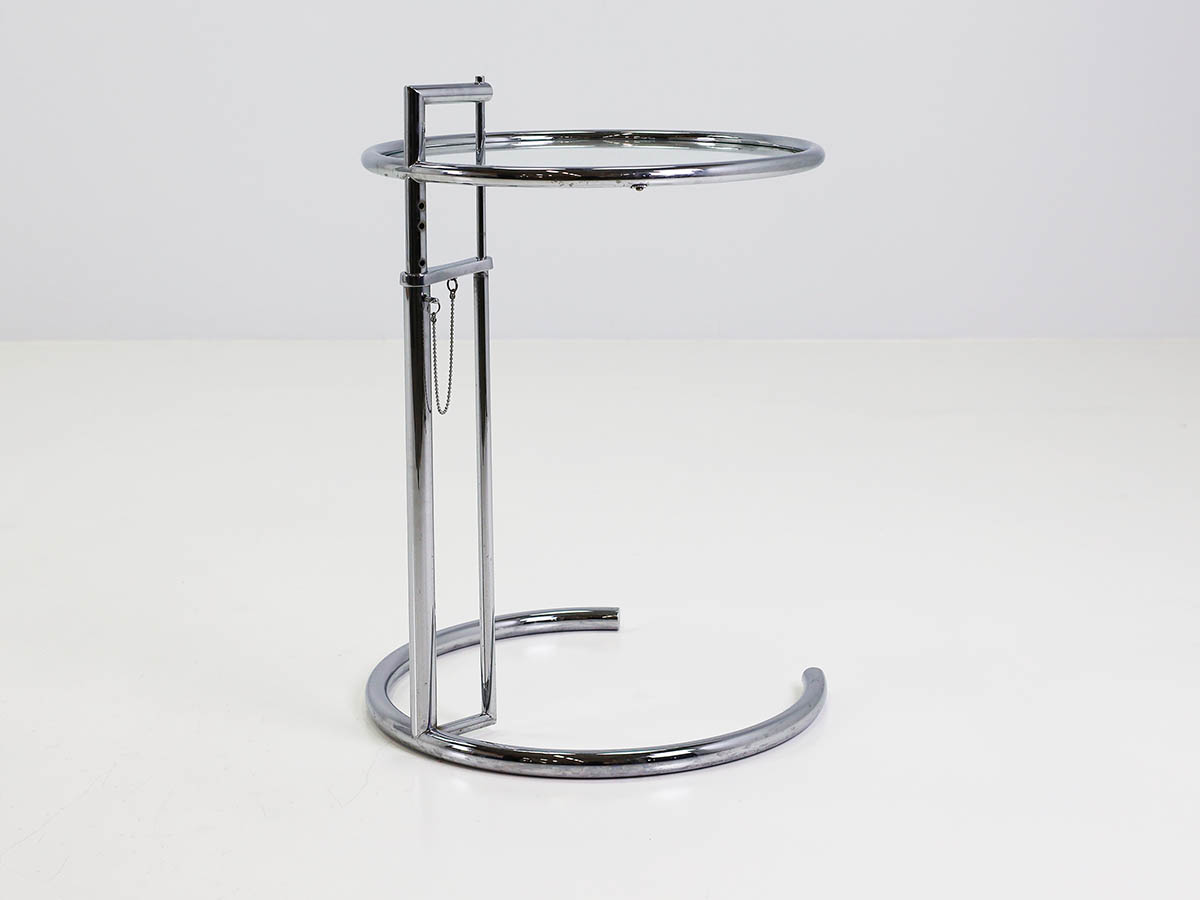
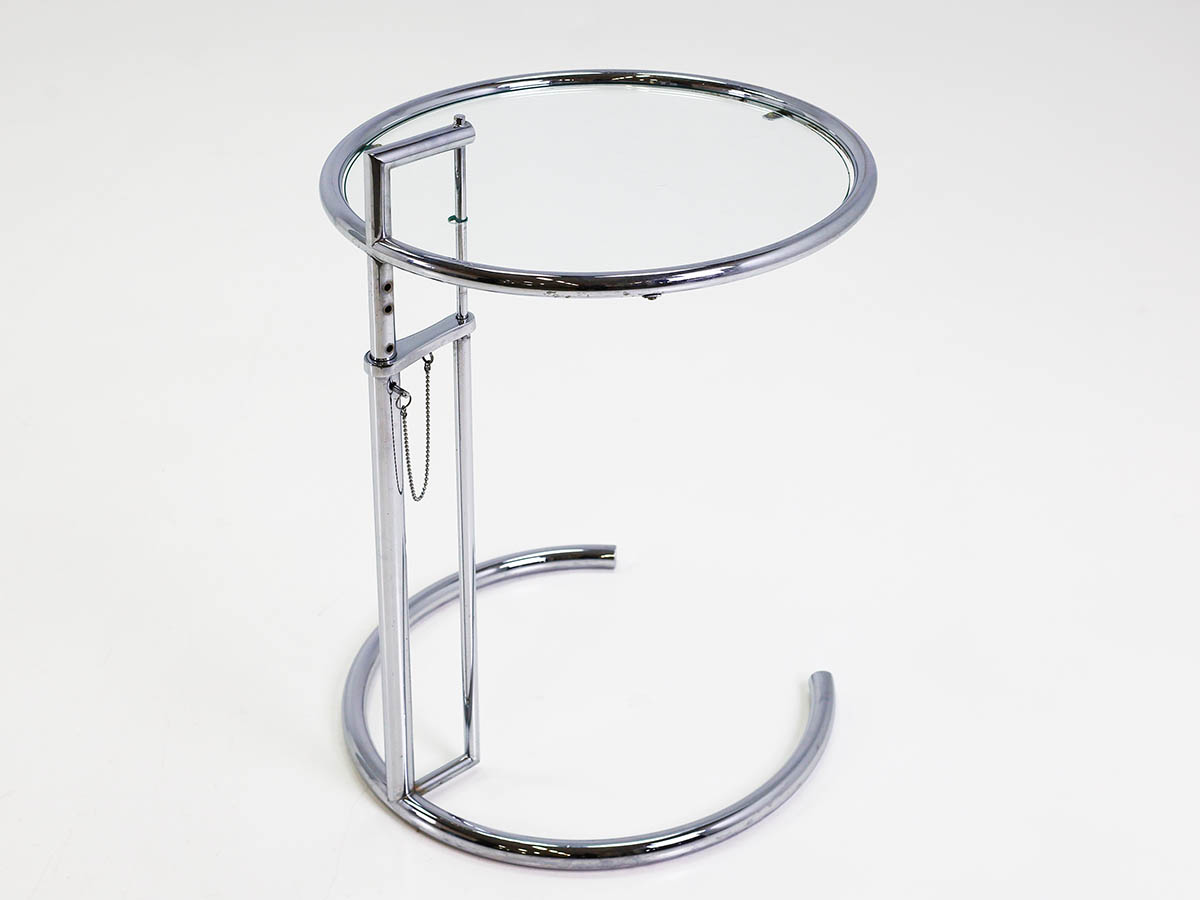
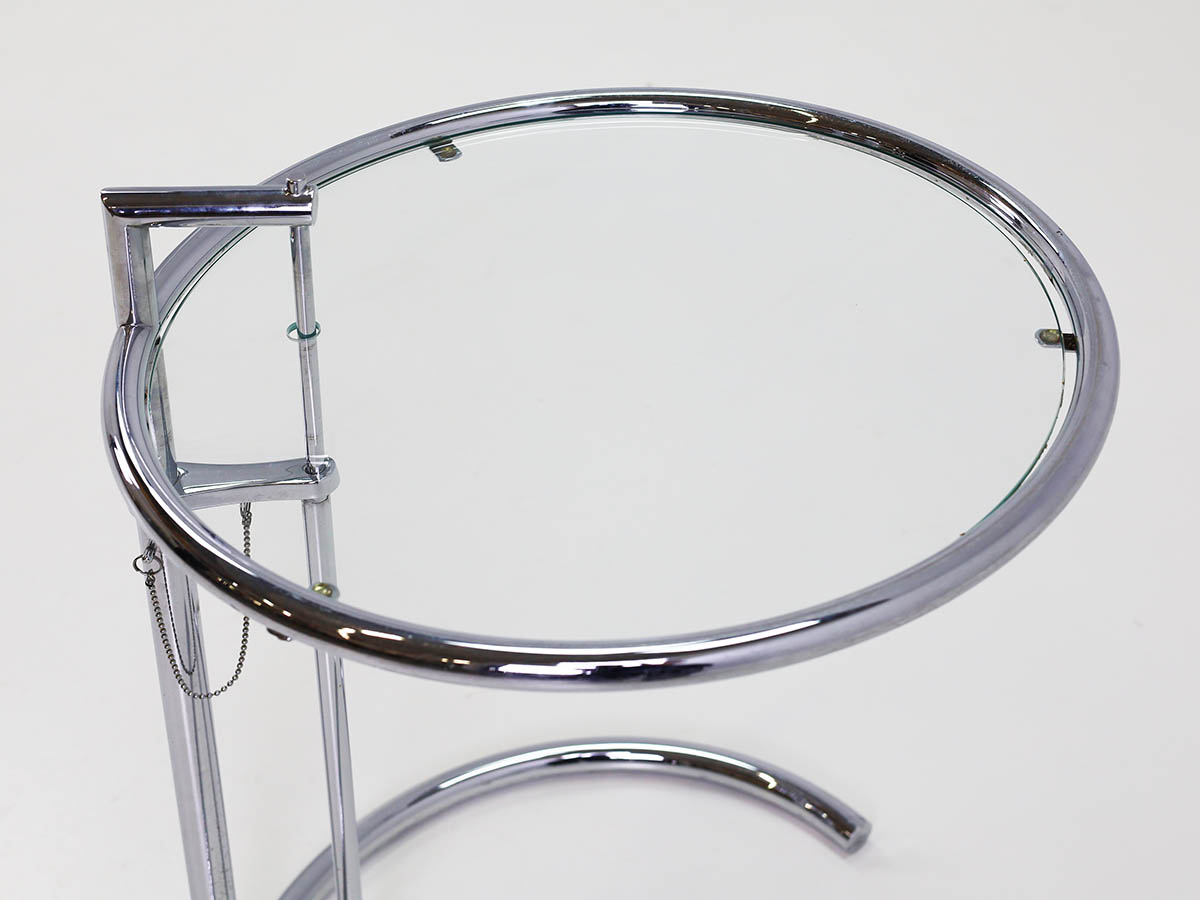
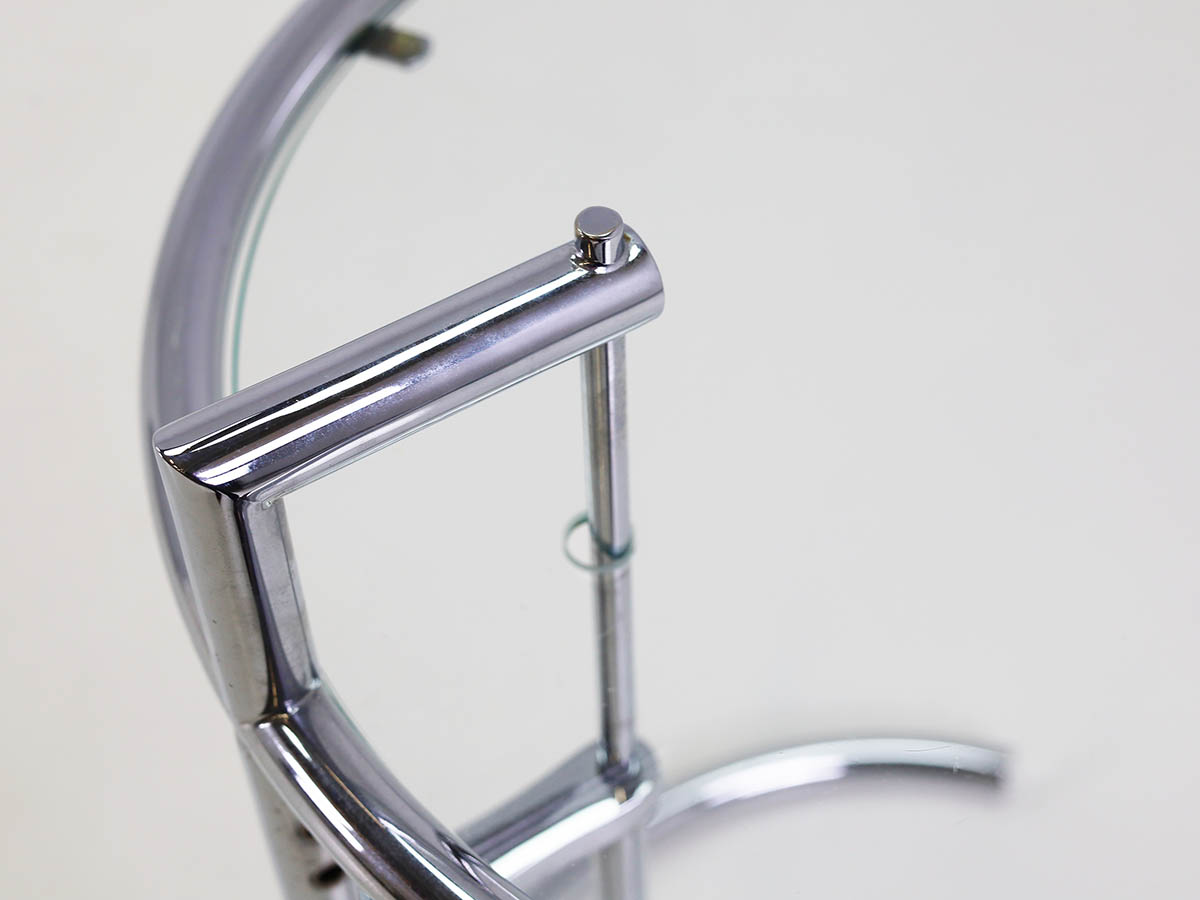
Originally intended for use beside a bed, the table is distinguished by its minimalist tubular chrome-plated metal frame and circular transparent glass top.
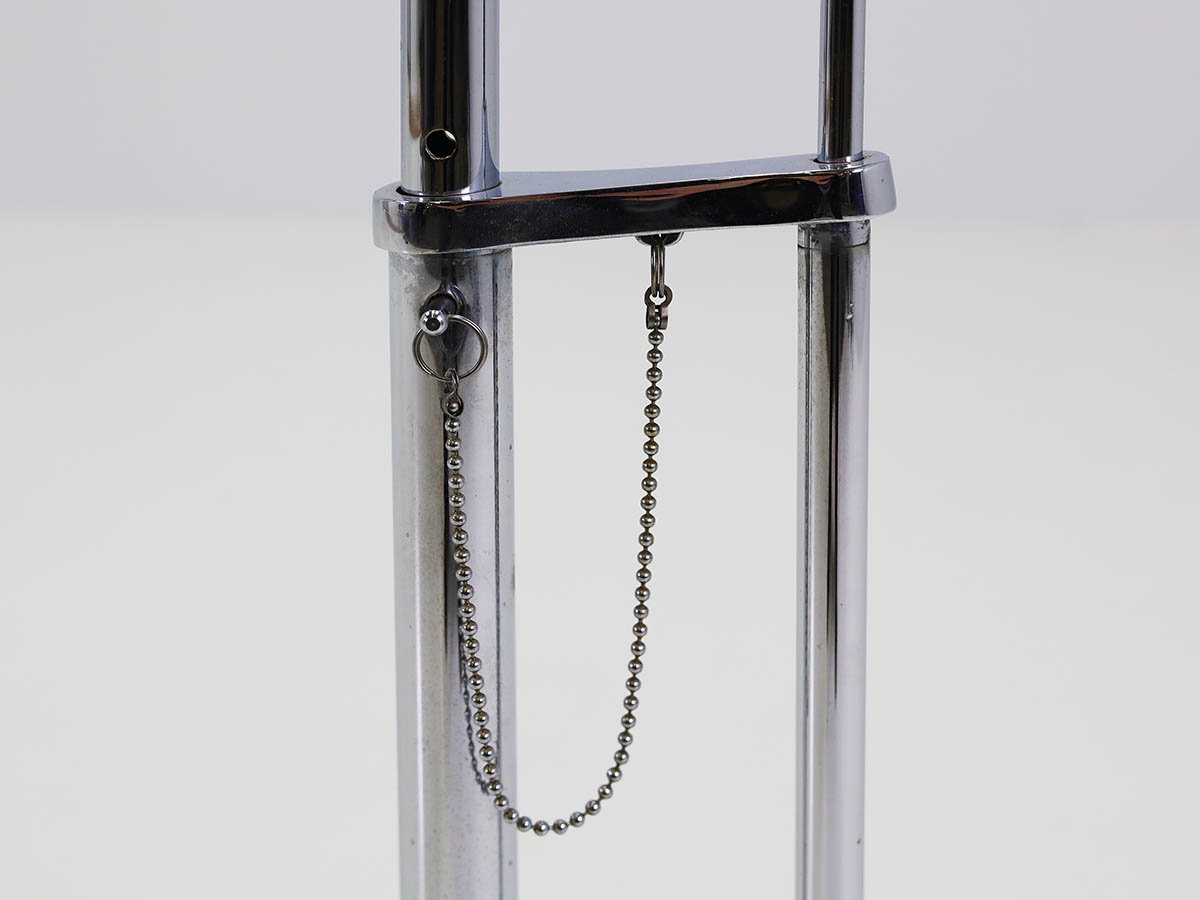
Its most innovative feature is the adjustable height of the top, which slides along the vertical support. A simple locking mechanism with a pin and chain allows it to be secured at the desired height.
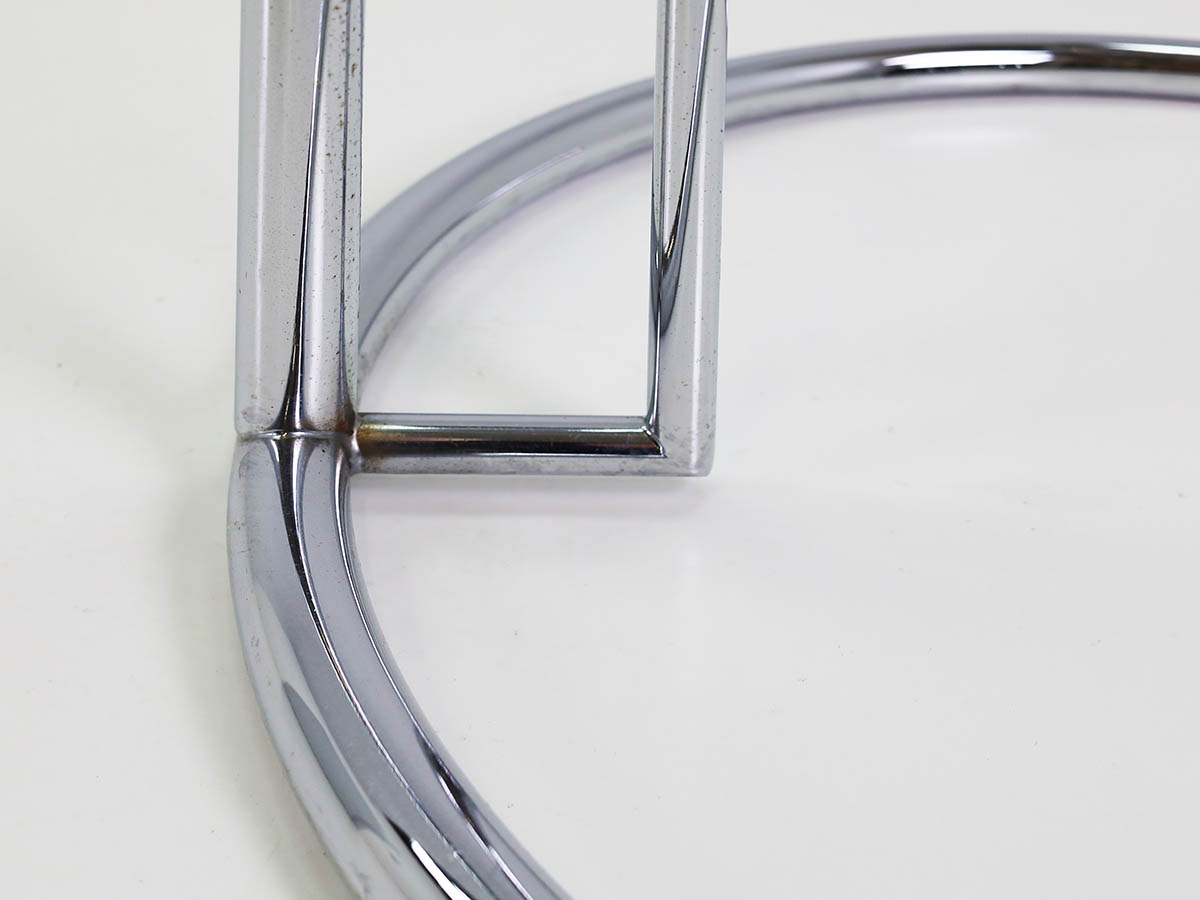
The base also reveals particular attention to practical use: its open, semicircular shape allows it to slide partially beneath a bed or beside an armchair, bringing the tabletop closer to the user.
The structure almost disappears visually, thanks to the lightness of the chrome-plated tubular frame and the transparency of the glass. The result is an object in which every component serves a precise functional purpose without sacrificing exceptional formal elegance.
The E1027 perfectly expresses Gray’s design philosophy: design should not impose its presence, but rather adapt to everyday life and the needs of the person using the object.
Production in the 1970s: Aram Designs and Vereinigte Werkstätten
A particularly interesting chapter in the history of the E1027 table concerns its industrial production and international distribution from the 1970s onwards.
After a long period during which Eileen Gray’s work had remained relatively little known, the late 1960s saw a gradual rediscovery of her creations.
In 1973, designer and gallery owner Zeev Aram, founder of the London-based Aram Designs Ltd., approached Eileen Gray with the proposal to bring some of her most important designs back into production.
Gray accepted this collaboration and in 1973 granted Aram Designs Ltd. worldwide production and distribution rights for her designs.
This was a fundamental moment in the history of design: many of her creations could now be produced through authorised industrial manufacturing, maintaining a direct relationship with the original designs and their creator.
At the same time, Germany also played an important role in the dissemination of her work.
Vereinigte Werkstätten für Kunst im Handwerk, a historic company based in Munich, produced and distributed Eileen Gray furniture under licence, contributing to the circulation of her designs throughout the European market.
Vereinigte Werkstätten represented an important presence in the history of post-war German design, with particular attention to construction quality, design research and the production of contemporary furniture.
Their involvement in the authorised production of Eileen Gray’s furniture constitutes a significant chapter in the collecting history of her designs.
It is therefore important to distinguish between the two historical roles: Aram Designs Ltd. received worldwide production and distribution rights for Eileen Gray’s designs in 1973, while Vereinigte Werkstätten was one of the authorised manufacturers contributing to the production and distribution of her furniture in Germany.
The Historical and Collectible Value of the Early Authorised Productions
The editions produced by Vereinigte Werkstätten represent an important testimony to the first period of rediscovery and international circulation of Eileen Gray’s designs.
For collectors, an example manufactured in Germany during this period is of particular interest, especially when its manufacturer, provenance and date of production can be documented.
In the case of the E1027 table, the presence of an original label, manufacturer’s mark or numbering attributable to Vereinigte Werkstätten can make a significant contribution to identifying the piece.
However, it is essential to distinguish between the date of the original design, 1927, and the production date of the individual piece. An attribution to 1973 must be supported by appropriate documentary or construction-related evidence: the date on which production rights were granted to Aram does not, by itself, establish that every German example was manufactured in that particular year.
The production of Vereinigte Werkstätten therefore represents an important testimony to the European circulation of Eileen Gray’s designs and their rediscovery during the 1970s.
Eileen Gray: A Legacy That Transcends Time
Eileen Gray died in Paris on 31 October 1976, at the age of 98.
During her lifetime, she did not always receive the recognition she deserved. For a long time, her work remained overshadowed by that of other leading figures of Modernism, despite her ability to anticipate architectural and design solutions of extraordinary modernity.
Today, she is recognised as one of the fundamental figures in the history of 20th-century design.
Her works are held in the collections of some of the world’s most important museums, including the Museum of Modern Art in New York and the Centre Pompidou in Paris.
The E1027 table remains one of the most emblematic expressions of her design philosophy: an apparently simple object in which every detail is the result of profound consideration of the relationship between form, function and space.
Its ability to combine geometric rigour, technical innovation and human sensitivity makes it an enduring classic of international design.
Owning an E1027 means preserving a tangible testimony to this extraordinary period of design history and to the authorised production that contributed to the rediscovery of Eileen Gray’s work.