

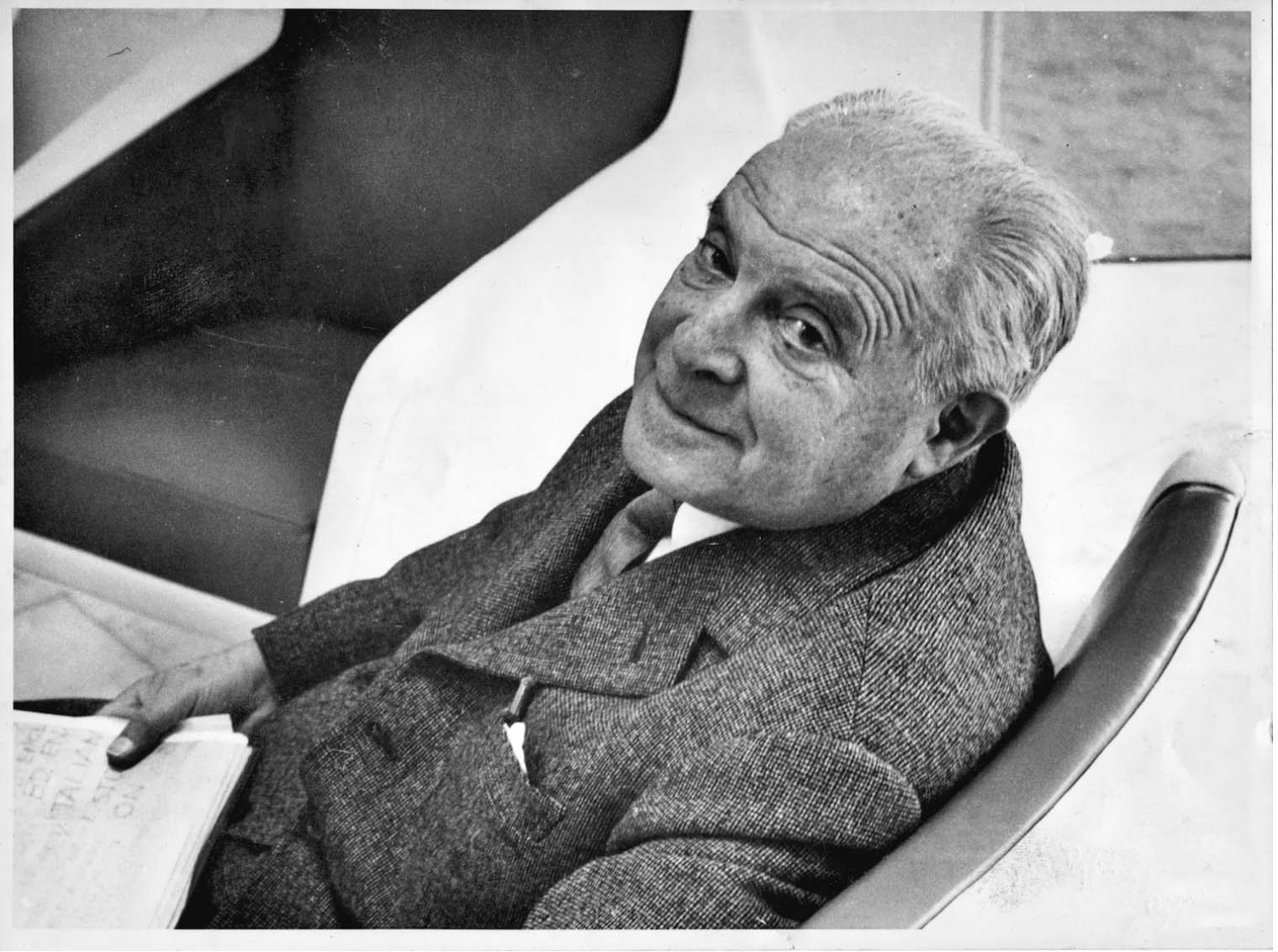
Some designers leave behind buildings, furniture and objects. Others leave behind an idea, a way of looking at the world. Gio Ponti belongs to this second category.
An architect, designer, artist, publisher and tireless observer of contemporary life, Ponti spanned much of the twentieth century with inexhaustible curiosity. He designed houses, skyscrapers, chairs, lamps, ceramics, cutlery, door handles, interiors and everyday objects, never considering these disciplines as separate territories. For him, everything belonged to a single design culture: the art of making life more beautiful, intelligent and harmonious.
Born in Milan in 1891, Gio Ponti was one of the most influential figures in the birth and international recognition of Italian design. His work embodies a distinctive vision of modernity, far removed both from the coldness of functionalism and from nostalgia for the past. It was an elegant, vibrant and sophisticated modernity, in which tradition could meet innovation without losing its identity.
Gio Ponti: Biography, Education and His Vision of Italian Design
His career began to take shape in the 1920s, a period of profound cultural and industrial transformation. After graduating in architecture from the Politecnico di Milano in 1921, Ponti began developing his own distinctive language, initially drawing inspiration from the Italian decorative tradition.
In 1923, he became artistic director of Richard Ginori. This was a decisive experience: through ceramics, he explored a new relationship between art and industry, demonstrating that even an object intended for mass production could possess a strong artistic identity.
In 1928, he founded Domus, a magazine that would become one of the most important international platforms for architectural and design culture. More than just a publication, it became the place through which Ponti observed, interpreted and helped shape his time.
His curiosity knew no boundaries. He wrote, taught, travelled, met artists and architects, and engaged in dialogue with both industrial manufacturers and skilled craftsmen. In his vision, design was never an isolated exercise: it was a form of culture.
From a Small Object to a Skyscraper: Gio Ponti’s Design Philosophy
Few twentieth-century designers moved so naturally between such different scales. Gio Ponti’s output is extraordinarily extensive and remarkable in its diversity: a fork, a door handle, a coffee maker, a chair, a lamp, a piece of furniture, an interior, all the way to a skyscraper. Objects so different in size, function and purpose, yet all belonging to one unmistakable creative vision.
This is one of the most extraordinary qualities of his work: his ability to maintain formal and design coherence regardless of the scale of a project. Ponti never considered a small object a lesser exercise, nor did he regard architecture as a discipline separate from design. Every project deserved the same attention to proportions, function, materials and the quality of its form.
Throughout his work, spanning decades of activity and an astonishing variety of typologies, runs a common thread: a particular sense of lightness, an instinctive understanding of proportion, a balance between geometry and movement, and the ability to make even the simplest forms elegant.
This coherence never meant repetition. On the contrary, Ponti was a designer in constant evolution, experimenting with different languages, techniques and materials without ever losing his identity. Each object possesses its own personality, yet seems to belong to the same creative universe.
It was as though he could recognise, in every single thing, its most appropriate form. The grandeur of a building and the precision of a piece of cutlery thus become different expressions of the same design culture.
Perhaps this is where his most profound modernity lies: in demonstrating that good design does not depend on the size or apparent importance of what is being created, but on the quality of the thinking behind it.
Beauty in Gio Ponti’s Design: Function, Form and Everyday Life
To understand Gio Ponti’s design, one must begin with a simple yet revolutionary belief: beauty should be part of everyday life.
A piece of furniture should not simply be useful. It should have proportion, rhythm and character. A home is not merely a space to be organised, but an environment to be lived in, one capable of reflecting the personality of those who inhabit it.
Ponti constantly sought a balance between function and emotion, discipline and imagination. His creations can be essential in form, but they are rarely anonymous. Even when reducing a design to its fundamental elements, he always preserved a certain grace, an almost playful lightness.
It is this sensitivity that makes his work so recognisable and, even today, remarkably contemporary.
Colour in Gio Ponti’s Italian Design
There is another element running throughout Gio Ponti’s work that contributes to its unmistakable identity: his extraordinary sense of colour.
For Ponti, colour was never an additional decorative feature or a detail to be chosen at the end of a project. It was an integral part of the composition, a material to be used with the same attention given to form, proportions and materials.
His palette ranged from delicate, luminous shades to more intense and unexpected combinations. Blues, greens, yellows, pinks, reds and deeper tones came together in carefully considered arrangements, giving objects and interiors a distinctive personality. Sometimes colour emphasised a geometric form; at other times, it created contrast, visually lightened a structure or introduced a lively note into an otherwise essential space.
This sensitivity is particularly evident in the ceramics created for Richard Ginori, the enamelled objects developed in collaboration with Paolo De Poli, as well as in his furniture and interiors. Colour thus became a connecting element between different disciplines, a common thread linking architecture, design and the decorative arts.
Ponti had a remarkable ability to use colour without weighing down a form. His combinations could be bold, yet they always retained a sense of balance and elegance. They were never intended to surprise for their own sake: they helped create an atmosphere, define a space and bring an object to life.
Perhaps this is also why so many of his works still possess such extraordinary freshness today. In a Ponti design, colour does not belong solely to its own era: it shares the same lightness and modernity that define his forms.
Gio Ponti’s Superleggera Chair: The Story of a Cassina Design Icon
In 1957, one of the most iconic objects in the history of Italian design was created: the Superleggera chair, manufactured by Cassina.
The design was inspired by the traditional Chiavari chair, reinterpreting it through an extraordinary investigation into structure, proportions and weight. The result is a chair of remarkable simplicity, built around the idea that every component must serve a purpose.
The Superleggera weighs just over one kilogram. Yet its true lightness is not merely physical: it is the result of a design philosophy that knows how to remove without impoverishing, simplify without becoming banal.
This may be the secret behind many of Ponti’s greatest designs. Behind an apparently spontaneous form lie extensive research, precision and a profound understanding of materials.
And yet the Superleggera represents only one part of his creative universe. The Leggera chairs, Dezza armchairs, tables, bookcases and furniture designed over the decades reveal a much broader exploration, in which domestic function becomes an opportunity for experimentation.
FontanaArte and Gio Ponti: Lighting, Glass and Italian Lighting Design
Another fundamental chapter in his work concerns his relationship with light.
In 1932, Gio Ponti and Pietro Chiesa gave life to FontanaArte, one of the most significant ventures in the history of Italian glass design and lighting. The project emerged from the meeting of architectural culture, artistic research and traditional craftsmanship. Light became a material to be designed, filtered and shaped. Glass, with its transparency and ability to multiply reflections, became an integral part of the architectural language.
The 0024, Bilia, Pirellina and Pirellone lamps bear witness to this period of experimentation and to the dialogue between designers and manufacturers that established FontanaArte as an international reference in lighting design.
These are objects in which geometry and material meet naturally: spheres, discs, cylinders and transparent surfaces create compositions of remarkable balance.
Ponti understood that a lamp does more than illuminate a room. It can transform the perception of an interior, define space and become an architectural element in its own right.
His exploration of light found another expression in the chandeliers and lighting fixtures designed for Arredoluce. Here, lighting design translated into structures and compositions capable of defining an entire interior, with particular attention to proportions, materials and the visual presence of each object.
Gio Ponti Objects and Details: Brass, Enamel and Collectible Italian Design
Gio Ponti’s greatness is not expressed solely through architecture and his most celebrated furniture designs. An equally fascinating part of his production can be found in the objects and details that accompany everyday domestic life: seemingly simple elements in which formal research meets the quality of traditional craftsmanship.
Among his most interesting collaborations was the one with Paolo De Poli, a master of enamel on metal. Their collaboration produced door handles, small accessories and objects in enamelled brass, distinguished by luminous surfaces, intense colours and essential forms. These creations reveal a sophisticated dialogue between metal and enamel, transforming even a functional detail into a small decorative masterpiece.
Another noteworthy chapter is represented by the folding chairs manufactured by Reguitti. In their simplicity, these pieces of furniture perfectly illustrate Ponti’s interest in lightness, practicality and intelligent construction. The possibility of folding and storing a chair is not merely a functional solution; it becomes an integral part of the design itself. An object should be beautiful, useful and naturally adaptable to domestic spaces.
It is precisely these projects, sometimes less familiar than the major icons of Ponti’s design, that reveal the extraordinary breadth of his design culture. From architecture to the smallest everyday objects, Ponti recognised the potential of every element to contribute to the quality of living.
For collectors today, discovering these productions means uncovering a particularly precious aspect of twentieth-century Italian design: one in which design meets craftsmanship and beauty becomes part of even the most ordinary gestures of everyday life.
Gio Ponti Architecture and Interiors: From Villa Planchart to the Pirelli Tower
His vision of living finds some of its most complete expressions in the architecture and interiors he created in Italy and abroad.
In Milan, the Pirelli Tower, inaugurated in 1960, stands as one of the most powerful symbols of Italian modernity. With its slender silhouette, Ponti demonstrated how a large-scale building could achieve a remarkable formal quality through proportion, transparency and lightness.
Very different, yet equally significant, is Villa Planchart in Caracas, designed during the 1950s. Here, architecture, furniture, artworks, colours and landscape come together to create a unified environment. The intention was not simply to furnish a house, but to create a personal universe in which every detail finds its rightful place.
Perhaps it is precisely this ability to conceive an environment as a harmonious whole that reveals the most contemporary aspect of Ponti’s work.
Gio Ponti Collectible Design: How to Recognise Original Furniture and Objects
Decades later, Gio Ponti’s works continue to exert a particular fascination. They are not simply testimonies to a bygone era, but objects capable of crossing generations without losing their expressive power.
In the world of collectible design, original Gio Ponti furniture, lamps and decorative objects remain highly sought after for their design quality, the extraordinary variety of his production and their importance in the history of Italian design.
But approaching a work by Gio Ponti also means learning how to read it. The period of production, manufacturer, materials, construction techniques and execution details are all essential elements in understanding its identity. A design may have been produced in different periods, by different manufacturers and in different versions. Recognising its specific characteristics is an essential part of the research.
For this reason, an original piece of furniture is never simply a furnishing object. It is a tangible testimony to a way of thinking, a creative period and a precise understanding of quality.
Gio Ponti’s Legacy in Contemporary Italian Design
Gio Ponti left us far more than a collection of memorable objects. He passed on a vision in which architecture, design and everyday life cannot be separated.
His lightness was not superficiality, but knowledge. His elegance was not decoration, but balance. His modernity did not consist of chasing the future, but of knowing how to imagine it.
This is why his work continues to speak to collectors, architects, interior designers and anyone who recognises in a beautifully designed object something that goes beyond its function.
At Demos Mobilia, we share this appreciation for objects that have a story to tell. We seek value in proportions, material quality, authenticity and in the ability of a design to preserve its beauty over time.
Because good design does not belong only to its own era. It continues to live on in the spaces and in the lives of those who choose it.
Fashions fade. Good design endures.